
For fitness brands, wellness distributors, retailers, and private-label businesses, a mini massage gun for everyday use can be a valuable addition to a portable wellness product range. However, selecting the right model requires more than evaluating its size or appearance. Buyers must consider motor performance, battery life, operating noise, durability, safety features, and the needs of their target customers.
As demand for compact fitness accessories and convenient recovery products creates opportunities across different retail channels, B2B buyers need products that combine practical functionality with consistent manufacturing quality. Understanding these factors can help businesses choose a competitive mini massage gun, reduce sourcing risks, and develop a product line with long-term commercial potential.
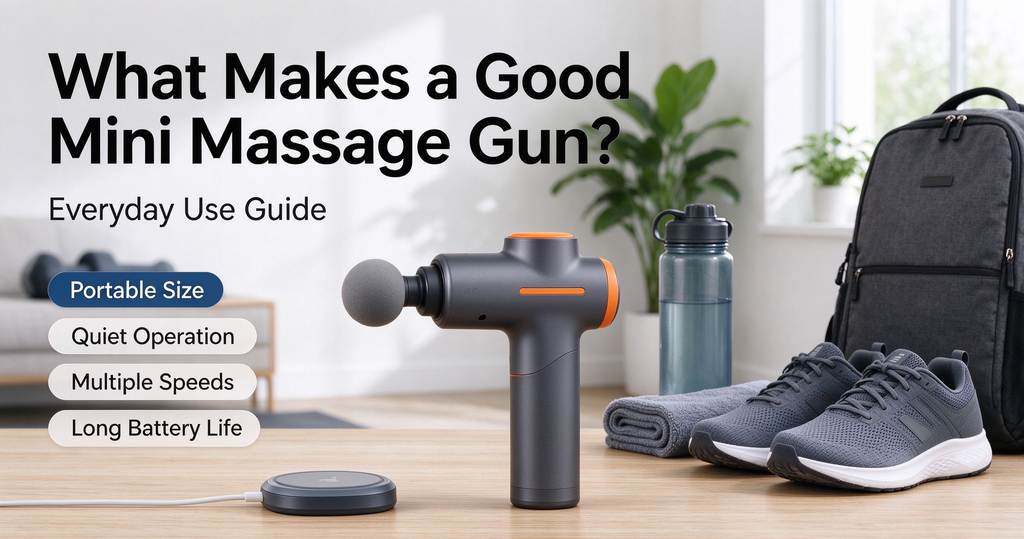
1. What Makes a Mini Massage Gun Suitable for Everyday Use?
A product designed for frequent use should balance portability, reliable performance, comfortable handling, and durability. For manufacturers and distributors, these characteristics also influence customer satisfaction, product returns, and brand reputation.
Compact Design Without Compromising Performance
The primary advantage of a mini massage gun is its compact form factor. A smaller device is easier to store, transport, and incorporate into travel, fitness, and lifestyle product collections.
However, mini models should not be evaluated by dimensions alone. Buyers should review the relationship between product size, weight, motor output, percussion amplitude, stall force, and operating stability.
A compact design should provide a practical balance between portability and performance. Manufacturers should be able to explain how their product specifications support the intended applications rather than relying on general claims such as “powerful” or “professional.”
Quiet Operation and Motor Quality
Operating noise is another important consideration for everyday-use products. Excessive noise may negatively affect the perceived quality of a device, particularly when customers use it at home, in offices, or in shared fitness environments.
Some mini massage guns use brushless motors to support efficient operation and consistent performance. However, noise levels depend on the motor, mechanical structure, housing materials, assembly precision, and operating speed.
B2B buyers should request noise-test data and compare samples under consistent conditions. They should also ask whether the manufacturer performs noise checks during mass production or only during product development.
Battery Life and Charging Convenience
A rechargeable battery should support the product’s intended use without making the device unnecessarily heavy or bulky.
Buyers should compare battery capacity, charging time, charging interface, protection features, and measured runtime at different speed settings. Battery capacity alone does not guarantee longer usable runtime because actual performance also depends on motor load and operating conditions.
For private-label projects, confirm the battery specifications, charger requirements, labeling, and applicable transport documentation before approving mass production.
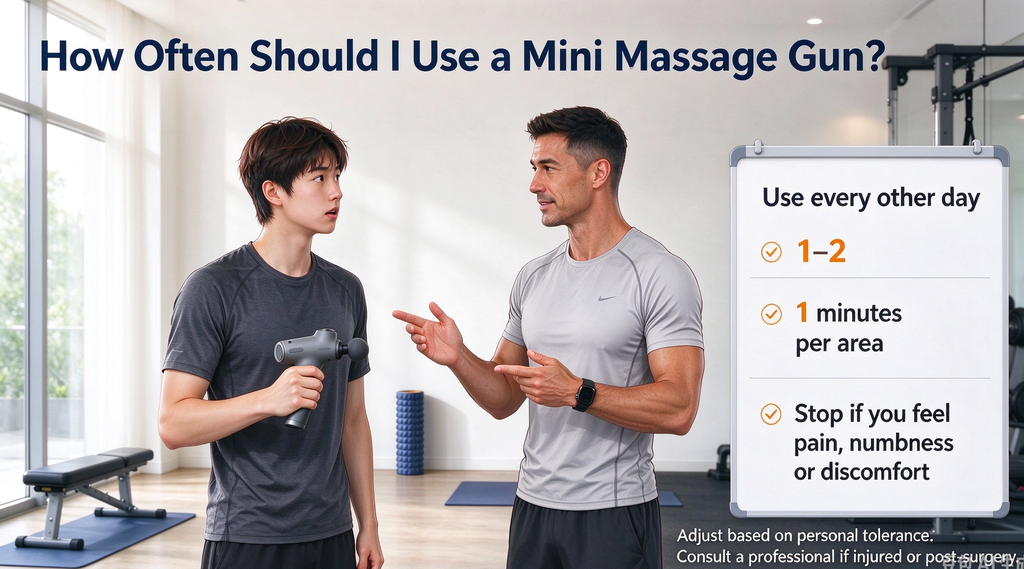
2. How Often Use the Mini Massage Gun? Understanding Usage Expectations
The question of how often use the mini massage gun is relevant to both end-user education and B2B product development.
For product buyers, usage frequency helps define the expected durability of the motor, battery, buttons, charging port, and internal components. A device intended for occasional travel use may face different demands from one marketed for regular fitness and wellness routines.
Manufacturers should therefore evaluate the expected duty cycle before finalizing the design.
For example, buyers can ask suppliers to document:
Motor operating-cycle or endurance test results
Battery charging and discharging test procedures
Button and control durability
Charging-port durability
Product performance after repeated operation
Inspection criteria for noise, vibration, and overheating
For consumers using the finished product, frequency and duration should follow the manufacturer’s instructions. More frequent use does not necessarily provide greater benefits, and massage guns should not be used on injured areas or areas where percussion is inappropriate.
From a sourcing perspective, clear usage guidance and realistic performance claims help brands reduce misunderstandings and build customer trust.
3. Can a Massage Gun Be Used Frequently? What Buyers Should Evaluate
Can a massage gun be used frequently is a useful question when evaluating whether a model is suitable for a regular-use product category.
The answer depends on the product’s engineering, operating limits, maintenance requirements, and intended applications. Frequent operation places repeated demands on the motor, battery, housing, attachment mechanism, and thermal management system.
For B2B buyers, several factors deserve particular attention.
Thermal Management
A compact device has limited space for internal components, making heat management an important engineering consideration.
Ask the supplier whether the product has undergone extended-operation testing and how temperature is monitored during testing. Confirm whether the operating instructions specify rest periods or other usage limitations.
Consistent Performance
A good product should deliver reasonably consistent performance across its intended speed settings and approved operating conditions.
Buyers should check for unusual vibration, changes in noise, unstable speed, loose components, or charging problems during sample evaluation.
Safety and Product Documentation
Product safety should be verified through appropriate testing and documentation for the intended destination market. Depending on the model and market, relevant requirements may involve electrical safety, electromagnetic compatibility, battery safety, and chemical compliance.
Do not assume that one certificate automatically covers every model or destination. Verify that the documentation matches the actual product and applicable requirements.
Brands should also provide clear instructions regarding sensitive areas, unsuitable applications, and circumstances in which users should seek professional medical advice.
4. How to Use a Massage Gun: Product Design and User Guidance
Understanding How to Use a Massage Gun is important when developing product instructions, packaging, and customer support materials.
Although the primary purchasing decision is commercial, user guidance can affect customer experience and product returns.
A well-designed mini massage gun should have intuitive controls, a secure attachment mechanism, clear charging indicators where applicable, and an ergonomic grip that supports controlled handling.
Manufacturers can help buyers develop useful instruction materials covering:
How to attach and change massage heads safely
How to select an appropriate speed setting
How to hold and move the device without excessive pressure
Which body areas should be avoided
How to clean and store the product
How to charge and maintain the battery correctly
For example, product instructions should advise users to start at a low setting, apply gentle pressure, and keep the device moving over suitable muscle areas rather than holding it on one spot for an extended period.
A massage gun should not be used directly over the head, front of the neck, bones, open wounds, or other unsuitable areas. Users with relevant medical conditions, injuries, or concerns should consult a qualified healthcare professional before use.
For international brands, professionally translated instructions and consistent safety information can also support smoother market entry.
5. What B2B Buyers Should Check Before Ordering in Bulk
Choosing a suitable product is only one part of successful sourcing. Buyers must also evaluate whether the supplier can maintain consistent quality, support customization, and deliver orders according to the agreed specifications.
Sample Testing Before Mass Production
Request samples before placing a large order. Evaluate actual dimensions, weight, grip comfort, motor noise, speed settings, charging performance, battery runtime, and accessory fit.
Where technical performance matters, request measurable specifications and supporting test reports instead of relying exclusively on a product catalog.
A documented sample approval process can establish a reference for later production batches.
Customization and Private-Label Options
A capable manufacturer may offer logo printing, custom colors, retail packaging, accessory combinations, and other model-dependent customization services.
Before production, confirm all artwork, color references, logo placement, packaging dimensions, labels, and product specifications in writing.
Buyers should also establish which changes require new samples, additional testing, tooling charges, or longer lead times.
Quality Control and Repeat-Order Consistency
A reliable supplier should have defined inspection procedures for incoming components, assembly, finished products, and packaging.
Ask how the factory identifies defective units, handles component substitutions, and records inspection results. For repeat orders, compare production samples with the approved reference sample to reduce variation in appearance and performance.
Total Cost and Minimum Order Quantity
The lowest unit quotation does not always produce the best commercial result.
Compare the complete cost structure, including the product, customization, packaging, testing, shipping, and other applicable expenses. Confirm the minimum order quantity for standard products and customized versions separately.
A clear quotation should specify the model, included accessories, packaging configuration, customization scope, delivery terms, and payment conditions.
6. Why Work With a Direct Factory for Mini Massage Guns?
Working with a direct factory can give B2B buyers a more direct channel for discussing product specifications, engineering limitations, customization, production schedules, and quality requirements.
For brands developing a mini massage gun for everyday use, this communication can be especially valuable when balancing compact dimensions, battery capacity, motor performance, and target pricing.
When evaluating a factory, consider its experience with similar products, technical support, sample development process, quality documentation, production capacity, and ability to accommodate repeat orders.
Do not judge manufacturing capability by factory claims alone. Request relevant evidence, review samples, and clarify which processes are performed in-house and which are outsourced.
A dependable manufacturing partner should be able to explain both the advantages and limitations of its products and provide realistic timelines for customization and production.
Conclusion: Choosing the Right Mini Massage Gun for Everyday Use
A successful mini massage gun for everyday use should combine a practical compact design with reliable motor performance, appropriate battery life, manageable operating noise, safe operation, and durable construction.
For B2B buyers, the decision should also account for target audience, intended applications, retail positioning, customization requirements, and total sourcing cost.
Before committing to mass production, evaluate product samples, review relevant test documentation, confirm usage instructions, and establish clear quality standards with the supplier.
Partnering with a capable direct factory can help brands develop customized products, improve production consistency, and build a competitive portable wellness product range. By focusing on verified performance and manufacturing reliability rather than appearance alone, businesses can make more informed sourcing decisions and establish a stronger foundation for long-term growth.