
A printed logo can make a mini massage gun recognizable. A full-color illustration can make it the centerpiece of a retail collection. Yet those two designs may call for different production processes.
For B2B buyers comparing mini massage gun printing methods, the decision involves more than image quality. Artwork complexity, panel shape, order quantity, setup cost, and print durability all affect the right choice. This guide compares UV printing and pad printing from a sourcing perspective, so you can prepare a clearer brief and evaluate supplier quotations with confidence.

How Mini Massage Gun Printing Methods Work
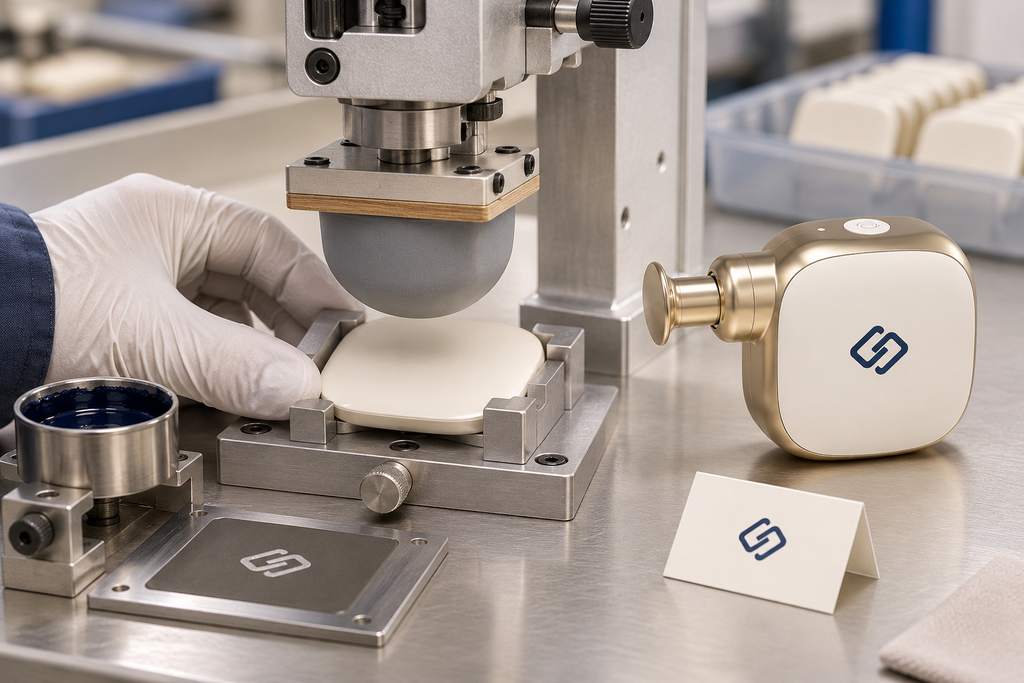
Pad printing transfers an image from an etched plate to a product using a flexible silicone pad. The pad can conform to small or irregular surfaces, making the process useful for logos and simple graphics. Each additional printed color requires careful alignment.
UV printing applies ink directly to the surface from a digital file and cures it with UV light. It is commonly considered for detailed, full-color designs, gradients, and projects with multiple artwork variations. The print setup still needs to account for the part’s shape, material, and surface finish. inkcups.com
Neither method is automatically more durable or more economical for every order. Ask the supplier to evaluate the specific massage gun model and actual print location before choosing a process.
| Buying factor | UV printing | Pad printing |
|---|---|---|
| Typical artwork | Full-color illustrations, gradients, detailed patterns | Logos, text, and designs with a limited number of solid colors |
| Artwork setup | Digital file preparation; no etched image plate | Etched plate required for the design and each printed color |
| Surface considerations | Often suited to accessible flat or gently curved areas | Flexible pad can reach some small or irregular areas |
| Multiple designs | Easier to change digital artwork between versions | New artwork may require new plates or setup |
| Main approval concern | Color, detail, placement, and ink adhesion | Ink color, placement, registration, and adhesion |
These are general production differences. The equipment, ink system, and geometry of your selected model determine what a factory can actually produce. inkcups.com
When Should Buyers Consider UV Printing?
UV printing is a strong candidate when artwork is the product’s main visual feature. Think of an illustrated front panel for a seasonal collection, a gradient used across several brand colors, or a detailed graphic that must remain recognizable in online product photography.
For example, an Amazon seller might want one massage gun design for a fitness campaign and another for a holiday promotion. Digital artwork can make it practical to discuss those variations without creating a separate etched plate for every image. That does not mean every quantity or design change is free: sample preparation, fixtures, printing time, and color approval still have costs.
When reviewing a UV printing massage gun sample, pay attention to the panel background. Full-color artwork printed over a dark panel may need a white ink layer to keep its colors visible. If the background is part of the design, ask whether it comes from the panel material or from the print itself. That choice affects how edges and unprinted areas look. rolanddga.com
Request a physical sample when color is important. A screen proof can confirm layout, but it cannot show exactly how ink will look on the selected panel finish.
When Is Pad Printing the Better Fit?
Pad printing often makes sense for a restrained brand treatment: a one-color logo, a short line of text, or a small graphic in a fixed position. It is also worth discussing when the intended print area has a contour that makes direct digital printing difficult.
A promotional products buyer, for instance, may be ordering one established design for a corporate gift program. In that situation, the plate and setup cost can be assessed against the planned volume and any expected repeat orders. A pad printing logo quote should state the number of print colors, the print location, and whether the price includes plate preparation.
Do not assume “two-color logo” means two colors will align perfectly on any panel. Small type, thin outlines, and overlapping shapes need particular attention during sampling. Ask to see the design at its actual printed size, especially if customers will first encounter it as a small image on an ecommerce listing.
Pad printing is capable of multicolor work, but each color adds production and registration considerations. For a photograph or complex illustration, ask the supplier to compare it with a UV-printed option rather than forcing the design into a limited-color format. inkcups.com
Start With the Panel, Not Just the Artwork File
A print process that works on a sample plastic sheet may behave differently on the finished part. The panel’s material, coating, texture, curve, and available printable area all matter. So does the location of buttons, seams, and the panel edge.
NBQ’s illustrated mini massage gun shows how a printed front panel can carry a pattern, illustration, or branded graphic. Its product information invites buyers to submit artwork and discuss the available printing options for the selected design. NBQ
Before approving a layout, ask for a print-area drawing or marked product photo. Confirm:
- The maximum printable area and the margin from each panel edge
- Whether the surface is flat, textured, coated, or curved
- Which way the logo faces when the product is displayed
- Whether any part of the design will be obscured by the assembled body
- How the panel artwork relates to the box design
These details are particularly important for corporate gift buyers whose logo must be visible at a glance, and for retailers planning photography across several product colors.
Test the Print on the Actual Production Surface
An attractive first sample does not prove that an ink will bond reliably to every version of a panel. The ink formulation and any surface preparation should be chosen for the actual material. Changes in plastic composition or additives can also affect adhesion. Industry printing guidance recommends testing the production part rather than relying only on its material name. inkcups.com
For UV printing, ask whether the selected surface needs cleaning, treatment, or primer, and how curing will be checked. Printer manufacturer Mimaki notes that inadequate curing and unsuitable surface preparation can contribute to poor adhesion. MIMAKI INDIA PRIVATE LIMITED
For either process, agree on a practical inspection plan before the order is placed. Depending on the project, it may include a documented adhesion check, visual inspection for missing ink, and a controlled rub or handling test. Define how the test is performed and what result counts as acceptable. A vague promise that printing is “scratch resistant” is difficult for a buyer or supplier to verify.
Ask to review the assembled gun as well as the loose panel. A finished sample reveals whether the artwork still looks centered after assembly and whether the print is exposed to contact during packing.
Compare Total Project Cost, Not Only Unit Price
Printing quotations can look similar while covering different work. To compare suppliers fairly, send the same artwork and order details to each one.
Request separate confirmation of:
- Sample cost: Does it cover a digital proof, a printed panel, or a complete assembled unit?
- Setup cost: Are plates, print fixtures, color preparation, or artwork adjustments included?
- Unit price: Is the price based on one logo, full-panel artwork, or several color versions?
- Revisions: What happens if placement or color changes after the first sample?
- Repeat orders: Can the approved artwork, plate, fixture, and sample reference be used again?
- Packaging: Is a printed gift box quoted and approved separately?
A low-volume collection with several illustrations may favor one cost structure; a larger repeat order with a simple logo may favor another. Ask for quotations at your expected first-order quantity and your likely reorder quantity. That gives a more useful basis for deciding than a single unit-price comparison.
Approve a Sample That Can Guide Production
The best approval sample is a finished product made as close as practical to the intended order: correct panel color, print method, artwork size, logo position, and packaging presentation.
Record the approved artwork version and sample date. If you approve a minor difference from the original design, describe it in writing. Keep a physical reference where possible and ask how the factory will compare production units against it.
For buyers selling across the US, UK, Europe, or other markets, also confirm the packaging and documents needed for each destination with the supplier. Printing approval and market documentation are separate purchasing decisions; settling both before production helps prevent late changes to the box or product presentation.
Conclusion: Choose the Process Around Your Product Plan
The right mini massage gun printing methods depend on what you are selling. UV printing is often worth evaluating for detailed, full-color panel artwork and frequent design changes. Pad printing is often worth evaluating for compact logos and repeatable, limited-color designs.
Send suppliers the actual artwork, target quantity, product model, panel color, destination, and intended print location. Then compare physical samples, the complete quotation, and the proposed production checks. That process will tell you far more about a supplier’s fit for your brand than a printing-method label alone.