
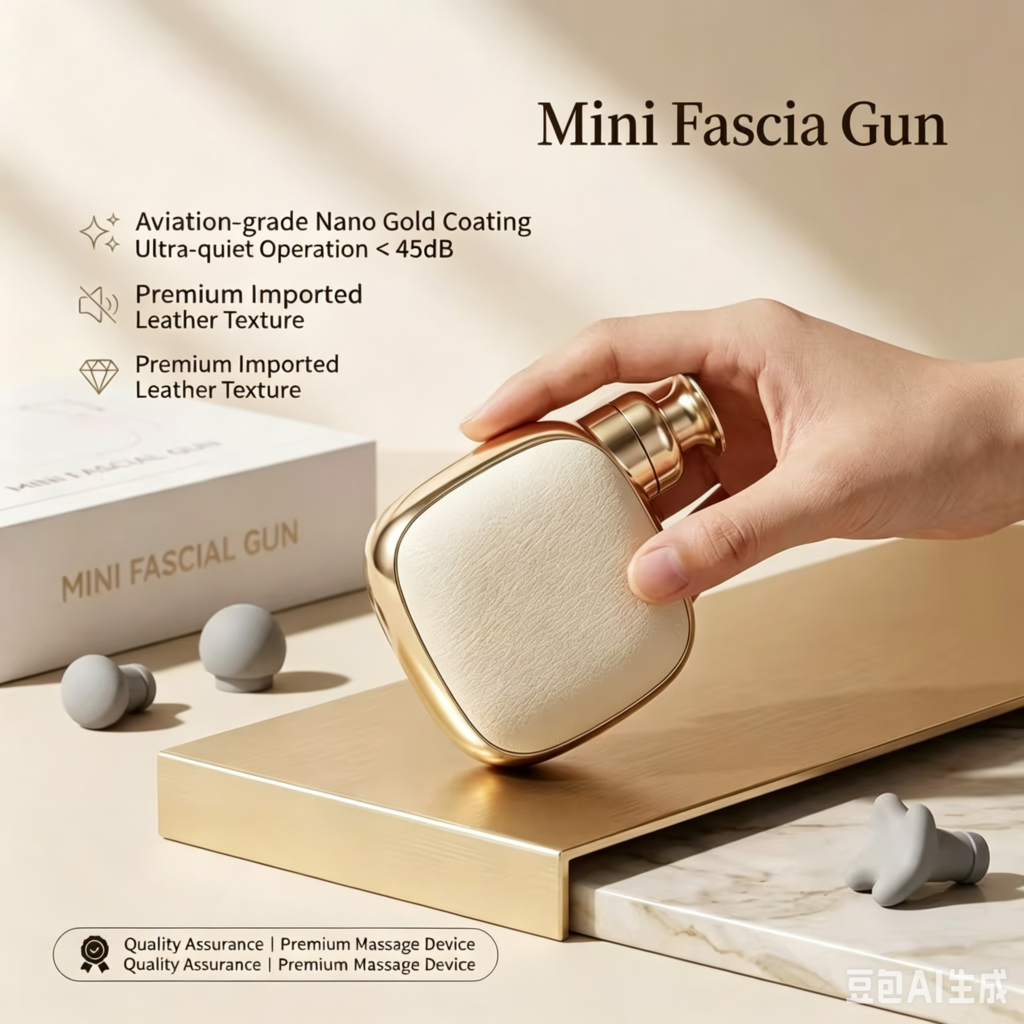
The mini fascia gun, a compact portable percussive therapy device, has gained wide popularity among office workers, fitness enthusiasts and travelers. However, many industry reports feature unverifiable data. This article offers an evidence-based overview of the global fascia gun market (including mini models), relying on data from reputable research firms, and analyzes regional dynamics, product innovations and core challenges.
1. Total Global Fascia Gun Market Size (2026)
There is no authoritative data for mini fascia guns alone, as most reports cover the broader massage/fascia gun category. Key 2026 estimates from major research firms are as follows:
- LP Information: Projects the market to grow from $1.09 billion in 2025 to $1.97 billion by 2032 (CAGR 8.9%), with a 2026 value of about $1.2–1.3 billion.
- Fairfield Market Research: Estimates the 2026 market at $1.6 billion, reaching $2.78 billion by 2033 (CAGR 8.2%).
- Grand View Research: Focuses on massage guns, valuing the 2025 market at $491.6 million and projecting $921.4 million by 2033 (CAGR 8.2%).
- Intel Market Research: Puts the 2025 market at $1.05 billion, rising to $1.18 billion in 2026 and $2.15 billion by 2034 (CAGR 7.8%).
In summary, the 2026 global fascia gun market (including mini models) is estimated at $1.1–1.6 billion, while the widely cited $7.8 billion figure lacks verification from major public research.
2. The Mini Fascia Gun Sub‑Segment
Dedicated data for mini massage guns is limited. Global Info Research values the 2024 global mini massage gun market at $409 million, projecting it to reach $671 million by 2031 (CAGR 7.4%). This means mini models account for 30–40% of the total fascia gun market.
3. Regional Market Shares – What We Actually Know
Granular regional data for mini fascia guns is unavailable, but for the overall market, analysts agree on the following:
- North America: The largest regional market, driven by high wellness spending and early adoption of percussive therapy.
- Asia‑Pacific: The fastest-growing region, boosted by rising fitness awareness, growing disposable income and robust local manufacturing (mainly in China).
European markets have lower sales volume but higher average prices, thanks to strict CE certification and consumer preference for premium, low-noise, intelligent models.
4. Key Players and Product Innovations (2026)
Major brands are focusing on portability and smart connectivity for product upgrades:
- Therabody: Launched the third-generation Theragun Mini in early 2025 (20% smaller, 30% lighter, ~300g), featuring Bluetooth and AI-driven personalized massage routines.
- Hyperice: Its Hypervolt line offers Bluetooth-enabled models for app-controlled speed adjustment and guided routines.
- SKG (Chinese brand): Introduced ultra-light mini guns (e.g., F3mini, 210g) targeting Asian-Pacific female consumers with pastel colors and prices below $80.
- Philips & Panasonic: Entered the segment with low-noise motors (<40 dB) and ergonomic designs for office and home use.
5. Application Scenarios and Consumer Diversification
Post-workout recovery remains the main use case, but mini guns are also widely used for:
- Office neck and shoulder relief (popular in North America, Europe and Japan)
- On-the-go travel relaxation
- Mild rehabilitation (under physician guidance)
- Personal care (especially among female consumers, who prefer lighter vibration and stylish designs).
The female segment drives growth, though exact market share data is unavailable. Brands have responded with gender-specific designs and beauty retailer collaborations (e.g., Philips × Sephora in Europe, SKG × Korean cosmetic brands in Asia).
6. Regulatory Environment
Regulatory oversight has been tightened globally:
- EU MDR: Classifies devices with therapeutic claims as Class IIa, requiring CE certification and clinical evaluation.
- US FDA: Does not classify ordinary massage guns as medical devices but monitors safety issues and issues recalls if needed.
- Japan & South Korea: Issued voluntary industry standards for noise, vibration and battery safety.
- ASEAN: Working on mutual recognition of product certifications to facilitate cross-border trade.
These regulations have increased entry costs, pushing out non-compliant small workshops and consolidating market share among established brands.
7. Persistent Challenges
Despite market growth, the industry faces several key challenges:
- Intense price competition: Over 120 global brands have driven entry-level mini gun prices below $50, squeezing margins for non-top players.
- Lack of clinical evidence: Only 42% of physical therapists recommend percussive therapy, citing insufficient safety and efficacy research for specific groups (e.g., the elderly, pregnant women).
- Supply chain volatility: High-performance motors and lithium batteries are concentrated in East Asia, with raw material and logistics cost fluctuations affecting production.
- Consumer misinformation: Improper use (e.g., on joints) in emerging markets leads to injuries, damaging brand reputation.
8. Outlook to 2030
The fascia gun market (including mini models) is expected to grow at a 7–9% CAGR through the early 2030s, with key trends including:
- Smart integration: More sensors, AI coaching and data logging for premium models.
- Niche customisation: Products tailored to specific sports, age groups or recovery needs.
- Brand consolidation: Leading brands with strong R&D and global distribution will expand share, while smaller brands focus on localized or specialized offerings.

Conclusion
In 2026, the global fascia gun market (including mini models) is valued at $1.1–1.6 billion, not the unsubstantiated $7.8 billion. Mini models, worth $400–500 million, have strong growth potential. North America leads regionally, while Asia-Pacific drives volume growth. To sustain development, the industry must address evidence gaps, regulatory hurdles and price competition. For businesses, data-driven strategies and compliance are critical; for consumers, informed usage is key to reaping benefits.