
Why Your Approved Sample Should Become a Production Reference: The Mini Massage Gun Golden Sample
A buyer approves a sample, places an order, and expects every finished unit to look and work the same way. Yet “sample approved” can mean different things to the brand, the salesperson, and the production team. A mini massage gun golden sample gives everyone a physical reference for the product they agreed to make.
For a private label launch, that reference is especially useful. The device may have a custom panel color, printed logo, selected massage heads, and branded packaging. Each detail affects the product your retailer or end customer receives. The goal is to connect sample approval to the purchase order, production checks, and final inspection.

Why an Email Saying “Approved” Is Not Enough
A photo can confirm the general appearance of a mini massage gun. It may not show the panel texture, the alignment of a printed logo, the fit of an attachment, or the contents beneath the packaging insert. Even a physical sample can create confusion if it was hand-finished or assembled with components different from those planned for production.
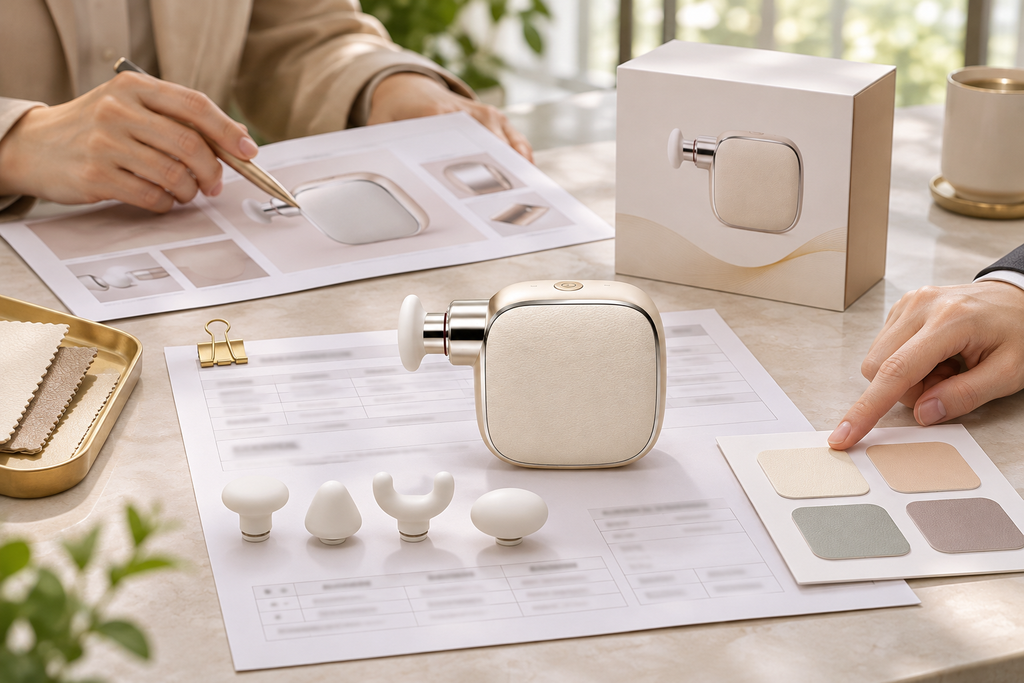
Suppose a brand approves a cream panel with a gold-colored frame. Weeks later, the factory begins assembling an order using a different panel batch. Both sides may believe the color is “close enough,” but neither has agreed on how to judge it. A retained reference sample, supported by written acceptance criteria, gives the discussion a starting point.
Independent inspection providers use reference samples alongside order requirements to compare production goods with what the buyer approved. They may check appearance, function, accessories, markings, and packaging at different production stages. SGS USA
What Makes an Approved Production Sample Useful?
An approved production sample should represent the intended order configuration as closely as possible. That includes the product finish, installed components, accessories, instructions, and retail packaging. If any part is temporary, label it clearly before approval.
For example, a printed panel might be final while the sample box uses provisional artwork. In that case, approving the device does not approve the box. Record those decisions separately. Do not let a general “sample approved” message imply acceptance of details the buyer has not reviewed.
Give the reference an identification record:
- Product model and SKU
- Sample revision number and approval date
- Buyer and supplier approval contacts
- Approved artwork and packaging file versions
- Included accessories and their quantities
- Any approved exceptions or remaining changes
Ideally, the buyer and factory each retain an identified physical sample. If a third-party inspector will review the order, arrange access to the same approved version or provide a documented comparison set. Keep clear photographs of every side, but treat them as supporting records rather than a substitute for the physical item.
Mini Massage Gun Golden Sample: A Buyer’s Comparison Checklist
Use the table below as a sample comparison checklist when reviewing early production units and packed goods. Decide which items can be judged visually and which require a measurement, test method, or written specification.
| Checkpoint | Compare with the sample | Also define in writing |
|---|---|---|
| Panel and frame | Color, texture, gloss, fit, visible gaps | Color reference and acceptable variation |
| Logo or artwork | Size, position, orientation, edge quality | Final artwork file, print area, and durability check |
| Device assembly | Buttons, seams, charging-port position, finish | Approved components and workmanship criteria |
| Massage heads | Shape, material appearance, attachment fit | Types, quantities, and fit requirements |
| Operation | Button response and speed selection | Performance criteria and test method |
| Charging items | Cable and connector supplied | Approved cable specification and included quantity |
| Retail pack | Insert fit, printed design, contents, barcode | Artwork version, market copy, and packing list |
For NBQ’s customizable mini massage gun range, buyers can discuss logo printing, panel colors, artwork, and branded packaging. That makes it particularly important to identify the exact combination approved for each SKU. NBQ
A checklist should answer one practical question for every row: What would cause us to accept, question, or reject a production unit? If the answer is only “it should look good,” the supplier still has to guess.
Know What a Physical Sample Cannot Prove
The reference is strongest for visible and tactile details. By itself, it cannot confirm the battery specification inside every unit, the consistency of an entire production run, or whether a product meets the requirements of its destination market.
Put those requirements in the purchase specification. Depending on the project, this may include component identification, functional test procedures, packaging labels, required documents, and any independently verified claims. Agree on who checks each requirement and what evidence the supplier will provide.
Be careful with subjective descriptions such as “quiet,” “premium finish,” or “strong vibration.” If a feature matters to your listing or retail buyer, ask the factory how it will be measured under defined conditions. A sample can show the desired experience; the written specification makes repeatable checks possible.
This distinction protects both parties. The factory knows which differences matter, and the buyer has a clearer basis for reviewing production without treating every natural material or printing variation as a defect.
Use the Reference at More Than One Production Stage
The sample should not stay in a cabinet until the shipment is ready. Agree when production goods will be compared with it:
- Before production: Confirm materials, components, artwork revisions, and packaging files against the approved order.
- At first assembly: Compare initial finished units with the reference before the full run proceeds.
- During production: Check that color, printing, assembly, and function remain consistent as output increases.
- Before shipment: Inspect randomly selected, fully packed units against the reference and purchase specification.
This sequence is valuable when an issue can still be corrected without unpacking an entire order. Intertek describes pre-production checks of materials and accessories, inspections during manufacture, and final checks of finished goods that can cover function, color, size, and packing. intertek.com
Agree in advance on sampling, defect classifications, and what happens if units differ. A single approved sample does not mean every unit has been tested. The reference guides inspection; an inspection plan determines how the batch is checked.
Control Changes After Approval
A brand may revise its logo. An accessory supplier may change. A packaging designer may update the barcode or instruction copy for another market. These can be reasonable changes, but they should never enter production through an informal message that leaves the reference behind.
Use a short change record stating:
- What is changing, and why
- Which SKU and order quantity are affected
- Whether price or delivery timing changes
- Which files, specifications, and samples are superseded
- Whether a new physical sample needs approval
Consider a shared device sold in the United States and Europe with different packaging copy. The physical massage gun reference may remain the same, while each market needs its own approved packaging version. Identifying those versions separately helps the factory pack the right box with the right unit.
If a component or production method changes after approval, ask whether the change could affect appearance, operation, fit, or documentation. A revised photo may be enough for a minor artwork correction; a changed panel material or charging component may require a new physical sample and additional checks.
Questions to Ask Before Placing the Order
A supplier’s answer to “Can you make a sample?” is only the beginning. During supplier evaluation, ask:
- Can the final approved sample be made using the planned production materials and processes?
- Who retains the factory reference, and how is it identified?
- Will the approved files and specification be attached to the purchase order?
- When will first production units be compared with the reference?
- How will the factory report a deviation before continuing production?
- Can a buyer-appointed inspector access the reference and current specifications?
The answers show how a supplier turns an attractive sample into a repeatable order. They also help you budget for the right approval steps before committing to a retail launch or a time-sensitive gifting program.
Turn Sample Approval into an Order You Can Inspect
A mini massage gun golden sample is valuable because it connects the product you chose with the product the factory will make. Keep it identified, pair it with measurable specifications, and use it at agreed production checkpoints. When something changes, update the approval record before the new version reaches the line.
If you are developing a branded mini massage gun, send the factory your target quantity, destination market, logo and color references, accessory requirements, and packaging brief. Ask which details can be finalized in a physical sample and how that sample will be used to check your production order.
YOUR NEXT PROJECT
Get in Touch
Tell us how to reach you. We usually reply within 8 hours
CONTACT US
Ready to Talk?
We’re Here
to Help.
Tell us your target quantity, destination and customization ideas. Our team will help you review the product, branding and packaging options.
- Phone / WhatsApp
- +86 180 3816 1845
- Location
- No. 155, Meijing W Rd, Dongguan City, Guangdong Province