
A useful factory quote starts with a useful request. If you ask five suppliers for “a custom mini massage gun with our logo,” you may receive five prices for different products, accessories, packaging, and delivery terms. The lowest number may not represent the order you intended to place.
This mini massage gun RFQ template helps brand owners, importers, distributors, online sellers, and corporate gift buyers define their requirements before requesting prices. It also gives suppliers room to identify what is available, what needs development, and what must be confirmed through sampling.
Why a Short RFQ Often Produces an Unusable Quote
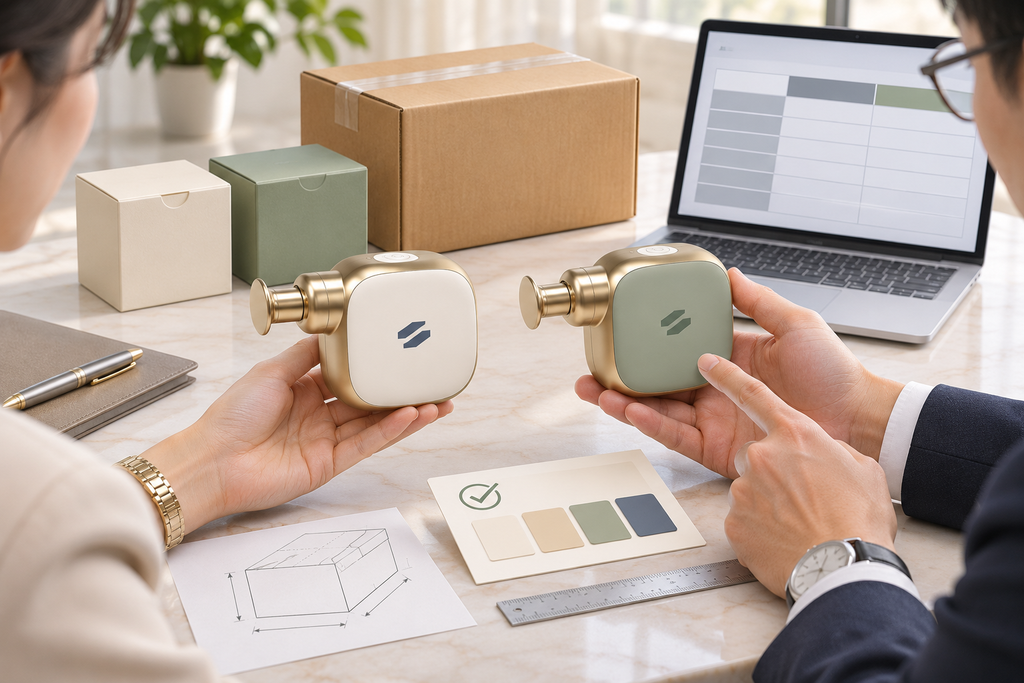
A mini massage gun can have several customization points. The product color, printed logo, illustrated panel, accessories, manual, and retail box may each affect the quotation. NBQ, for example, presents logo printing, panel artwork, selected colors, and branded packaging as options to discuss for its mini pocket massage gun range. The final configuration must be confirmed for the chosen model. NBQ
A clear massage gun quotation request should distinguish between requirements and preferences. If a specific logo position is essential, say so. If you are open to an existing color to meet a launch date, tell the factory. This helps the supplier propose a workable option without silently changing the scope.
The aim is not to write a lengthy technical specification before you have spoken to a manufacturer. It is to give every supplier the same factory sourcing brief, so the answers can be compared.
Mini Massage Gun RFQ Template: The Essential Fields
Use the following table as a checklist before sending your first inquiry.
| RFQ section | Information to provide | What to ask the supplier to confirm |
|---|---|---|
| Buyer and project | Company, sales channel, destination markets, target launch date | Contact person and quotation turnaround |
| Product | Preferred model or reference photo, intended configuration | Exact model, dimensions, materials, included components |
| Performance | Required speeds, battery, charging method, runtime, noise expectations | Test conditions and confirmed specifications |
| Branding | Logo, artwork, panel color, print location | Feasible method, print area, color reference, setup charges |
| Packaging | Retail box, inserts, manual languages, barcode needs | Box dimensions, artwork template, packaging cost |
| Quantity | Estimated first order and potential reorder volumes | MOQ and unit-price breaks by quantity |
| Samples | Number and type of samples needed | Sample cost, preparation time, revision policy |
| Quality | Inspection points and approved sample process | Testing available, acceptance criteria, inspection plan |
| Delivery | Destination, required arrival date, preferred shipping method | Production lead time, carton data, trade term |
| Commercial terms | Currency and requested quotation validity | Payment schedule, tooling charges, what the price includes |
You do not need a final answer for every row. Mark an item “supplier to recommend” when you want options. Leaving it blank makes it harder to tell whether a quotation includes it.
Define the Product Configuration Before Comparing Prices
Start with a model number or link to the product you are considering. If you have not selected one, send a reference photo and describe the size, appearance, and price position you need. Ask suppliers to name the exact model they quote. Two devices that look similar in a catalog may contain different motors, batteries, heads, or charging accessories.
Request the specification for the quoted configuration, including:
- Product dimensions and net weight
- Housing and panel materials
- Speed settings and the conditions used for any performance claims
- Battery type and capacity
- Charging input, connector, and supplied cable
- Included massage heads and other accessories
- Safety shutoff behavior, if applicable
If your brand needs a particular feature, describe the outcome you need rather than copying an unverified specification from another listing. For example: “Please quote a USB-C rechargeable model and confirm the charging input and included cable.” This gives the supplier a precise question to answer.
Ask the factory to flag substitutions. A quote should not quietly change the battery, motor, or accessory count to meet a target price.
Separate Branding Requirements From Product Requirements
For a private label project, specify exactly where the brand will appear. A logo on the box, a small logo on the gun, and a full-color front-panel design are different scopes of work.
Send a vector logo file if available, plus a visual mockup showing approximate placement. For panel artwork, include the full design and identify any colors that require a physical match. Ask for the maximum print area and an artwork template for the selected model.
Your RFQ should state whether you need:
- A standard product color or a custom panel color
- A one-color logo or a detailed printed illustration
- Branding on the product, the box, or both
- A standard box with a label or a fully customized retail box
- Multiple artwork versions within the same order
Request separate prices for each option you are genuinely considering. If a factory quotes a standard box while another quotes a custom printed box, their unit prices cannot be compared fairly.
Quote More Than One Quantity
Provide a realistic first-order estimate, then request price breaks at useful future volumes. For example, a buyer considering an initial order of 300 units might request prices at 300, 500, and 1,000 units. These are comparison quantities, not a claim about any factory’s MOQ.
If you need several colors or logos, explain whether the quantities are per design or total across the order. “500 units in three colors” could mean one combined order or 500 units of each color. Ask whether setup fees, carton packing, and lead times change for mixed variants.
For corporate gift projects, include the event date and the latest acceptable delivery date. For retail launches, distinguish your desired ship date from the date the goods must reach your warehouse. That difference may determine whether a customization route is practical.
Ask for the Right Samples and Approval Stages
A standard stock sample can help you assess the product’s size and function. It cannot fully approve a new printed panel or branded box. State which samples you need and what decisions each one must support.
A sensible approval sequence may include a stock unit, an artwork proof, a customized product sample, and a packaging proof. Ask whether the quoted sample will use the intended materials and production method. Also ask what happens if a logo is misplaced or a panel color needs revision.
Before bulk production, record the approved sample’s model, color, artwork version, accessories, and box. Decide which differences would require your written approval. This “approved sample” becomes more useful when both buyer and supplier know exactly which version it represents.
Include Quality and Market Documentation in the RFQ
Ask the factory what checks it can perform on the finished product and what records are available for your selected configuration. Your list might cover appearance, function, charging, accessories, packaging, and a pre-shipment inspection. Set acceptance criteria with the supplier before production rather than relying on the word “quality” alone.
For rechargeable models, tell the supplier your destination and intended shipping method early. Ask for battery specifications and available transport documentation, including the relevant battery test summary where applicable. IATA notes that equipment containing lithium batteries can require supporting information for air transport, and that the applicable shipping conditions depend on the shipment. iata.org
Likewise, ask which product reports, labels, manuals, and declarations are available for the specific model and market. Do not assume a document for one configuration automatically covers a modified version. Your importer or market adviser should confirm the final requirements for the destination.
Specify the Trade Term and the Place
“Shipping included” is too vague for a useful sourcing comparison. Ask suppliers to show the product price separately from freight if possible, and specify the requested Incoterms rule with its named place or port—for example, FOB [named port], Incoterms® 2020.
The named location matters because Incoterms rules allocate delivery responsibilities, costs, and risk at defined points. A quote marked only “FOB” or “DDP” leaves an important detail unresolved. library.iccwbo.org
Also request units per carton, carton dimensions, gross weight, and estimated carton count. These figures help an importer compare freight options and help an online retailer plan warehouse receiving. Ask whether shipping estimates are provisional until the final packaging is approved.
Copy-and-Paste Mini Massage Gun RFQ
Use this email as a starting point. Replace the brackets and remove options you do not need.
Subject: RFQ — Custom Mini Massage Gun for [Brand / Market]
Hello,
We are sourcing a mini massage gun for [retail / online sales / distribution / corporate gifts] in [destination market]. Our preferred model or reference is [link, model number, or attached image].
Product: Please quote the exact model and confirm dimensions, materials, speeds, battery, charging method, accessories, and retail-box contents. Please identify any specification that differs from our reference.
Customization: We need [logo location and print colors], [panel color or artwork], and [standard or custom packaging]. Artwork and color references are attached. Please confirm the available print area and any setup charges.
Quantity: Please quote [first-order quantity] and price breaks at [additional quantities]. We expect [number] color or artwork variants. Please state the MOQ per variant.
Samples: Please quote a stock sample and a customized sample separately, including cost, preparation time, and revision terms.
Quality and documents: Please describe your standard inspection process and list the product and battery documents available for this model and destination.
Delivery: Our target arrival date is [date]. Please state production lead time after sample approval, units per carton, carton dimensions, gross weight, and your price under [trade term and named place], Incoterms® 2020.
Please include quotation currency, validity, payment terms, and all one-time charges. If an alternative model better fits this brief, quote it separately and explain the differences.
Thank you,
[Name, company, contact details]
How to Compare the Replies
Once quotations arrive, put them into one comparison sheet. Check the model and specification first, followed by branding scope, sample type, MOQ per variant, packaging, lead time, documents, and delivery term. Only then compare unit prices.
A supplier who identifies a potential problem—such as artwork that is too close to a panel edge or a delivery date that leaves too little time for sample approval—may be giving you valuable purchasing information. Ask how they would resolve it and what the change would cost.
The strongest quotation gives your team a clear path from inquiry to approved sample, production, inspection, and shipment.

Conclusion
A mini massage gun RFQ template turns a broad product idea into questions a factory can answer and a buyer can verify. Define the model, configuration, branding, quantities, sample stages, quality expectations, and delivery terms before comparing prices.
If you are developing a branded project, browse NBQ’s mini massage gun range and send the factory your model preference, artwork, estimated quantity, destination, and target date. Ask for a quotation that makes each customization and one-time charge visible.