
When sourcing a mini massage gun for wholesale, private label, or OEM/ODM production, buyers need to understand more than motor speed and battery capacity. Massage gun amplitude is an important specification that describes the distance the massage head travels during each percussion stroke. It can influence product positioning, mechanical design, and the way a massage gun is differentiated in a competitive market.
However, a longer stroke does not automatically make a product better. Importers, distributors, and brand owners must evaluate amplitude alongside stall force, percussion speed, noise, weight, battery performance, and manufacturing quality. Understanding these relationships helps buyers choose suitable products, compare suppliers more accurately, and reduce risks before placing bulk orders.
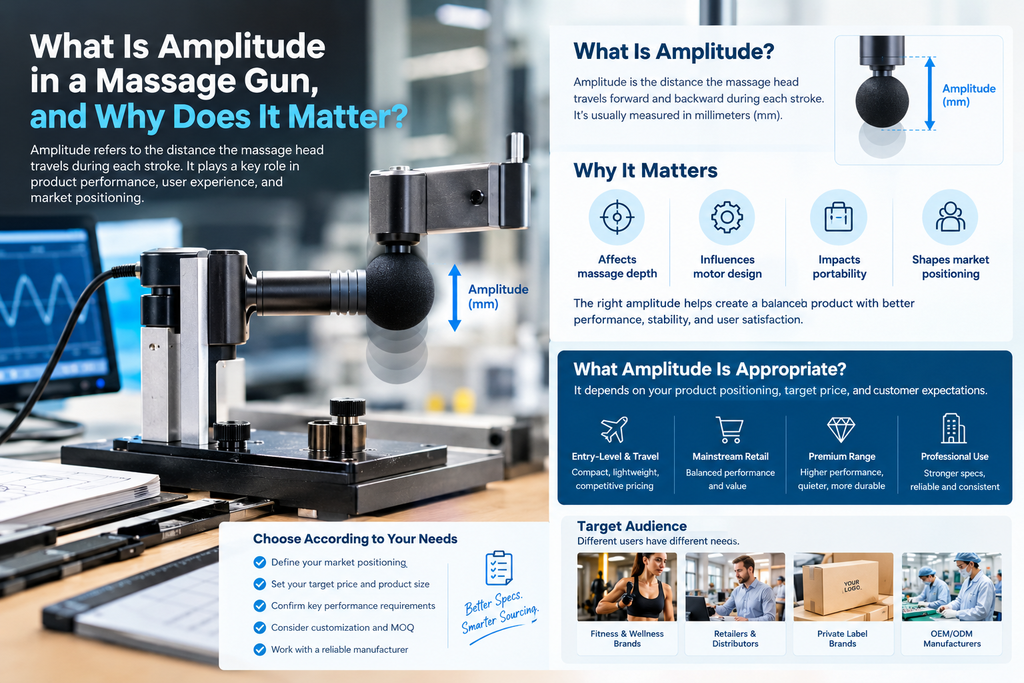
1. What Is Massage Gun Amplitude?
Amplitude refers to the distance the massage head travels forward and backward during operation. It is commonly expressed in millimeters (mm).
For example, a product advertised with a 10 mm amplitude has a nominal stroke distance of 10 mm if the manufacturer defines amplitude as the total travel distance. Buyers should confirm this definition because measurement terminology and methods may vary between suppliers.
Amplitude is different from percussion speed and stall force.
Amplitude: The distance traveled by the massage head during each stroke.
Percussion speed: The number of strokes completed per minute.
Stall force: The resistance a device can withstand before its movement stops or falls below a defined operating threshold.
Motor torque: A characteristic that influences the motor’s ability to drive the mechanism under load.
These specifications describe different aspects of performance. A high-speed massage gun may have a relatively short stroke, while a model with a longer stroke may require a different mechanical structure and motor configuration.
For B2B buyers, understanding these differences is essential when comparing technical specifications and evaluating whether a product meets the intended market requirements.
2. Why Does Massage Gun Amplitude Matter for Product Development?
Amplitude affects more than a product’s technical specification sheet. It can influence engineering decisions, product dimensions, operating characteristics, and overall cost.
A longer stroke generally requires the drive mechanism to accommodate greater movement. Depending on the design, this can increase the demands placed on connecting components, bearings, alignment, and housing clearance.
Manufacturers must balance stroke distance with motor performance, structural stability, noise control, and product durability.
For mini massage guns, this balance is particularly important because compact designs have limited internal space. Increasing stroke distance without reviewing the entire mechanical system may create unnecessary challenges involving vibration, heat, weight, or long-term reliability.
Buyers should also understand that amplitude alone cannot establish massage depth, effectiveness, or overall product quality. It is one technical indicator among several, and performance claims should be supported by appropriate testing.
When developing a private-label product range, the objective is to identify a configuration that meets the brand’s requirements without adding unnecessary cost or compromising reliability.
3. What Amplitude Is Appropriate for Your Target Market?
What amplitude is appropriate depends on the product category, intended positioning, budget, and customer expectations. There is no single specification that is ideal for every mini massage gun.
Instead of selecting the largest advertised number, B2B buyers should first define the product’s commercial purpose.
Entry-Level and Travel-Oriented Products
For compact, entry-level, or travel-oriented models, buyers may prioritize portability, manageable weight, convenient storage, and competitive pricing.
A shorter stroke may suit certain designs where compact dimensions and lightweight construction are priorities. However, buyers should still verify motor stability, product durability, and the intended performance requirements.
Mainstream Retail Products
For general retail and private-label product lines, a balanced specification may be more commercially attractive than an extreme performance profile.
Buyers should evaluate amplitude alongside speed settings, battery runtime, noise, ergonomics, and the quality of included accessories. A product that balances these characteristics can offer a more practical combination of performance and value.
Premium and Professional-Oriented Products
Products positioned in premium or professional-oriented segments may require more demanding performance specifications and stronger supporting test data.
In these cases, amplitude should be assessed alongside stall force, operating stability, mechanical durability, and thermal performance. A longer stroke may be appropriate for a particular product concept, but the complete design must be validated before it becomes a selling point.
The key purchasing principle is to match technical requirements to the intended application and price position rather than assume that a higher specification is always commercially superior.
4. Choose According to Your Needs: A Practical B2B Framework
To choose according to your needs, buyers should translate their market strategy into measurable product requirements before requesting quotations.
Start by identifying the following factors:
Product positioning: Determine whether the product is designed for entry-level retail, travel, mainstream wellness, or a premium product range.
Target price: Establish the expected retail price and target purchase cost. More demanding specifications may affect motor selection, mechanical components, testing requirements, and manufacturing costs.
Product dimensions: Define acceptable weight, length, grip dimensions, and packaging size. These factors can influence the available space for the motor and drive mechanism.
Performance requirements: Specify the required amplitude, speed settings, stall force, noise limits, and battery performance. Identify which specifications are essential and which are flexible.
Quality expectations: Establish requirements for durability, sample consistency, assembly quality, and finished-product inspection.
Customization needs: Confirm whether the project includes logo printing, housing colors, packaging, massage heads, or engineering modifications.
Once these requirements are documented, buyers can compare suppliers using the same evaluation criteria.
This approach reduces the risk of choosing a product based on an attractive quotation only to discover later that it does not meet the brand’s technical or commercial needs.
5. How Your Target Audience Influences Product Specifications
Your target audience should help determine the product configuration, but B2B buyers must distinguish market assumptions from verified demand.
For example, a brand targeting customers who value portability may prioritize a compact housing, lower weight, and convenient packaging. A brand developing a premium product may place greater emphasis on measured performance, finish quality, noise control, and durability.
These preferences do not automatically dictate a particular amplitude. Instead, they help define which technical characteristics deserve the greatest attention during product development.
Before selecting a specification, consider:
Which product features are most important in the intended sales channel?
What price range can the market realistically support?
How does the proposed model compare with competing products?
Which performance claims can be demonstrated through testing?
Will the chosen configuration support the brand’s long-term product range?
For distributors and private-label buyers, reviewing competitor specifications, customer feedback, product returns, and retailer requirements can provide useful evidence.
A factory should then help translate those commercial requirements into a technically feasible product specification. This collaboration is more valuable than simply requesting the highest available amplitude.
6. How to Evaluate Amplitude During Supplier Selection
A supplier’s specification sheet is a starting point, not proof of consistent production quality.
Before approving a sample, buyers should ask how amplitude is defined and measured. The supplier should be able to explain the measurement method, test setup, and relevant operating conditions.
Request several samples where possible. Measure them using the same method and compare the results against the agreed specification.
A practical supplier evaluation should cover:
| Evaluation factor | What buyers should verify |
| Amplitude measurement | Defined stroke distance and repeatable test method |
| Motor performance | Stable operation across agreed speed settings |
| Stall force | Test results under clearly defined loading conditions |
| Noise and vibration | Performance within agreed acceptance limits |
| Battery performance | Capacity, charging behavior, and runtime under defined conditions |
| Mechanical durability | Drive mechanism stability and component wear |
| Quality control | Inspection procedures, batch records, and corrective actions |
One important detail is measurement tolerance. Even when two suppliers advertise the same nominal amplitude, their measurement methods and acceptable production variation may differ.
Before mass production, define the nominal value, acceptable tolerance, measurement procedure, and inspection frequency in writing.
For customized products, changes to the motor, drive mechanism, or housing may affect stroke performance. Require technical review and appropriate revalidation before approving significant design changes.
7. Manufacturing and Procurement Factors Competitors May Overlook
Amplitude-related performance depends on the interaction of multiple components. A factory may advertise a specific stroke distance, but the buyer also needs to understand how that specification is maintained during mass production.
Ask whether critical drive components are inspected before assembly, whether alignment is controlled with suitable fixtures, and whether finished products undergo functional testing.
Another useful question concerns component substitutions. If a supplier changes a motor, bearing, connecting component, or controller to reduce costs or address a supply issue, the change may affect performance. A documented change-control process helps ensure that the buyer is informed and that relevant tests are repeated when necessary.
Buyers should also compare quotations using identical product configurations. Differences in batteries, massage heads, charging accessories, packaging, and quality-control requirements can make two apparently similar offers commercially unequal.
Finally, retain an approved reference sample and a written specification before production begins. Use both during pre-shipment inspection to verify that the delivered units match the approved design.
These measures can help reduce avoidable quality disputes, improve production consistency, and protect the brand’s reputation.

Conclusion: Make Better Purchasing Decisions with Massage Gun Amplitude
Massage gun amplitude is an important technical specification, but it should be evaluated as part of a complete product and supplier assessment. Buyers need to understand how stroke distance is measured, determine what amplitude is appropriate for their target market, and choose according to their needs rather than focus on the highest advertised figure.
A successful sourcing decision combines market research, clearly defined technical requirements, sample validation, and reliable manufacturing controls. By considering the target audience, product positioning, stall force, speed, battery performance, durability, and production consistency, B2B buyers can select a configuration that better supports their commercial objectives.
For importers, distributors, and private-label brands, working with a manufacturer that can explain its engineering decisions, provide credible test records, and maintain agreed specifications offers a stronger foundation for long-term OEM/ODM cooperation.