
When sourcing a mini massage gun for retail, private label, or wholesale distribution, buyers need to look beyond speed settings and product appearance. Mini massage gun stall force is an important performance indicator because it helps show how well a device maintains its percussion when pressure is applied to the massage head. For B2B buyers, evaluating this specification can help identify suitable products, compare manufacturers, and reduce the risk of inconsistent performance in mass production.
However, stall force should never be evaluated in isolation. Motor design, percussion amplitude, battery output, heat management, and product durability all influence the final user experience. Understanding how these factors work together allows importers, distributors, and brand owners to make more informed purchasing decisions.

1. What Is Mini Massage Gun Stall Force?
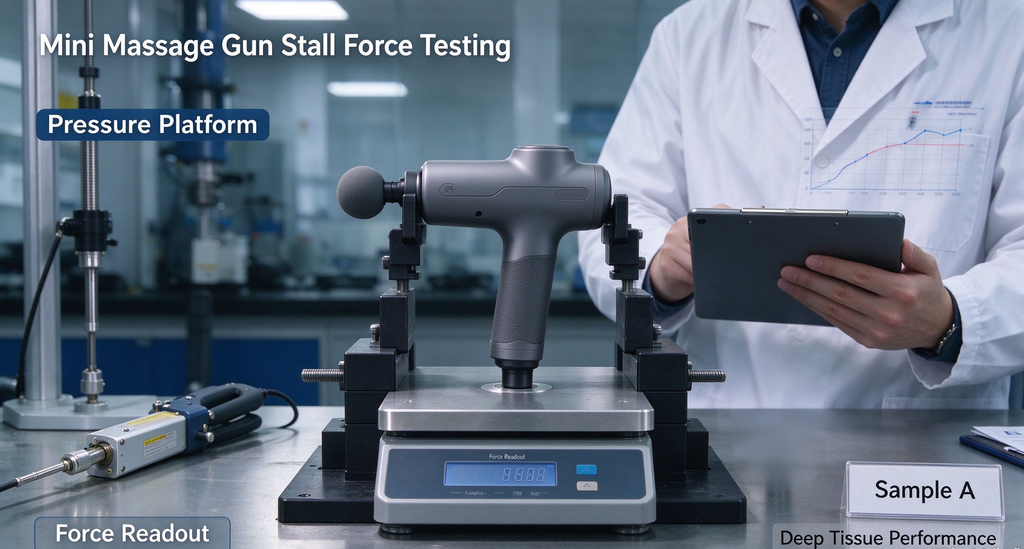
Stall force refers to the amount of force applied to a massage gun’s head before the motor stops or can no longer maintain its intended operation under the defined test conditions.
When a massage gun operates without resistance, its motor can move the massage head relatively freely. Once the head presses against a surface, the motor must overcome additional resistance. A device with insufficient torque or power management may slow down, lose percussion consistency, or stop when more pressure is applied.
For B2B buyers, stall force provides useful information about a product’s ability to maintain performance under load. It can be particularly relevant when evaluating models positioned for professional-style massage applications or deeper muscle engagement.
Nevertheless, there is an important limitation: stall force is not always measured using the same method across manufacturers. Differences in test equipment, speed settings, battery charge, attachment heads, and definitions of motor stall can produce figures that are not directly comparable.
Therefore, buyers should request both the stated stall force and the testing method used to obtain it.
2. Why Stall Force Matters for Deep Tissue Massage
Deep tissue massage is a common positioning for percussion massage devices, but buyers should avoid treating stall force as a complete measure of massage depth or effectiveness.
A massage gun’s performance depends on several interacting specifications.
Stall force and motor torque: These influence how well the device maintains its movement when resistance increases. A well-matched motor and control system can help reduce unwanted slowdowns under load.
Percussion amplitude: Amplitude describes the distance the massage head travels during each stroke. A longer stroke and a higher stall force represent different performance characteristics. One cannot automatically compensate for the other.
Speed settings: Different speed levels allow users to select different percussion rates. However, a high number of percussions per minute does not necessarily mean that a device maintains strong output under pressure.
Mechanical stability: The internal drive mechanism, bearings, connecting components, and housing structure can influence vibration, noise, wear, and long-term consistency.
For sourcing teams, the objective is not simply to purchase the model with the highest advertised number. It is to select a product whose measured performance matches the intended market position, price point, and expected operating conditions.
A compact massage gun designed for portability may require a different balance of weight, output, noise, and battery life than a larger professional-oriented model.
3. How to Test Mini Massage Gun Stall Force Before Ordering
A supplier’s specification sheet is a useful starting point, but it should not replace sample testing.
Before approving a bulk order, buyers can use the following evaluation process.
Step 1: Request a Defined Testing Method
Ask the manufacturer how stall force is measured. The procedure should identify the force gauge or testing equipment, operating speed, battery condition, attachment head, loading method, and endpoint used to define a stall.
For example, does the reported figure represent the force at which the motor completely stops, or the force at which its speed drops below a specified threshold?
These are different measurements and should not be treated as equivalent.
Step 2: Test Multiple Samples
Request several samples rather than evaluating only one demonstration unit. If possible, obtain units from a pilot production run or randomly selected production inventory.
Record the results for each sample under the same conditions. This helps identify unit-to-unit variation and provides a more realistic picture of manufacturing consistency.
Step 3: Compare Performance at Different Speed Settings
Test the device at low, medium, and high speeds. Record the applied load and the corresponding motor behavior.
A model may maintain its performance at one setting but slow down considerably at another. Buyers should understand these differences before finalizing product specifications or advertising claims.
Step 4: Repeat Tests Under Controlled Battery Conditions
Battery charge can influence motor output. For a more complete evaluation, test samples at a full charge and at a defined intermediate charge level.
Keep the testing conditions consistent and record the battery state for every measurement. This can help reveal whether performance changes significantly as the battery discharges.
Step 5: Document the Results
Create a test report containing the model number, sample identification, test conditions, measured results, and any abnormal behavior.
Use this report as a reference when approving the sample and establishing quality-control requirements for mass production.
A documented procedure makes supplier comparisons more meaningful than relying on verbal claims or isolated peak measurements.
4. How to Evaluate Motor Performance Beyond Stall Force
Stall force is only one part of a mini massage gun’s engineering performance. A product may achieve a strong peak reading but still perform poorly in other areas.
For a more complete assessment, B2B buyers should review the following factors.
| Evaluation factor | What buyers should verify |
| Motor design | Motor type, torque characteristics, operating stability, and supplier documentation |
| Percussion amplitude | Actual stroke distance and consistency across samples |
| Noise and vibration | Measured noise at defined distances and speed settings, plus unusual vibration |
| Battery performance | Verified capacity, runtime under a defined load, and charging behavior |
| Thermal performance | Temperature rise during representative operating cycles |
| Structural durability | Attachment retention, drive mechanism wear, housing integrity, and repeated-use performance |
| Production consistency | Variation between samples and compliance with approved specifications |
Brushless motors may be attractive for compact products because their design can support efficient operation and reduced mechanical wear in suitable implementations. However, the presence of a brushless motor alone does not guarantee high stall force, low noise, or long service life.
Buyers should evaluate the complete motor, controller, battery, and mechanical system rather than selecting a product based on one component specification.
It is also worth distinguishing no-load runtime from runtime under load. A supplier’s battery-life claim measured with the motor running freely may not reflect performance under more demanding conditions.
5. Muscle Relaxation Using a Mini Massage Gun: What Buyers Should Consider
Muscle relaxation using a mini massage gun is another common product-positioning consideration for brands developing portable wellness products.
From a sourcing perspective, buyers should assess whether the product provides a suitable balance of percussion performance, manageable weight, comfortable handling, noise control, and operating stability.
A high stall-force figure does not automatically establish that a device will deliver a better user experience. Excessive pressure is not the objective, and more aggressive percussion is not appropriate for every user or application.
For compact models, the engineering challenge is to balance useful output with portability. A lightweight housing, compact motor, and limited battery space can create trade-offs that differ from those of a full-size massage gun.
When reviewing a supplier’s product range, consider:
Whether the device maintains reasonably consistent percussion during representative use.
Whether the handle and housing remain comfortable to hold during normal operating periods.
Whether the selected massage heads fit securely and remain durable through repeated installation and removal.
Whether noise, vibration, and heat remain within the agreed product requirements.
Whether the product’s performance claims are supported by documented tests.
These checks help brand owners select products that fit their intended market rather than competing on a single headline specification.
6. Questions to Ask a Mini Massage Gun Manufacturer
Before placing a wholesale or OEM/ODM order, procurement teams should ask suppliers specific technical and production questions.
1. How is stall force measured?
Request the test method, measurement units, operating conditions, and supporting records. Confirm whether the stated value is a peak result or a repeatable performance target.
2. Can you provide test data from multiple units?
Ask for results from several samples and, where available, pilot production units. A single successful sample is not enough to establish production consistency.
3. How do you control performance during mass production?
A capable manufacturer should be able to explain its incoming material inspection, assembly controls, motor testing, finished-product inspection, and procedures for handling nonconforming units.
4. What happens when the motor is subjected to repeated loading?
Ask about endurance testing, heat monitoring, abnormal-noise checks, and any protective functions designed to respond to excessive load.
5. Can the product be customized without compromising performance?
Private-label projects may involve logo printing, housing colors, packaging, accessories, or changes to the battery and motor configuration. Ask which changes are cosmetic and which require additional engineering validation.
6. Can the approved sample be used as the production reference?
Agree on a written specification before mass production. Include stall-force test conditions, acceptable performance tolerances, amplitude, noise requirements, battery specifications, and other critical characteristics.
These questions help distinguish suppliers with documented engineering and quality-control processes from those relying mainly on marketing specifications.
7. Why Mass Production Consistency Matters More Than a Single High Reading
For importers and private-label brands, a product specification is valuable only when the manufacturer can reproduce it consistently.
A sample that performs well does not guarantee that every unit in a large order will meet the same requirements. Variations in motor components, battery cells, assembly tolerances, controller settings, and mechanical fit can affect output.
To reduce this risk, buyers should establish a clear quality agreement before approving production.
The agreement should specify the stall-force measurement method, sampling plan, test conditions, acceptance criteria, and corrective actions when results fall outside the agreed range.
Where stall force is a critical selling point, buyers may also consider independent pre-shipment inspections or third-party laboratory testing. The appropriate level of verification depends on order volume, product positioning, market requirements, and the consequences of a performance failure.
Another practical step is to retain an approved reference sample and record its model revision, firmware or controller configuration where applicable, battery specification, and attachment design. If the factory later changes a critical component, the buyer can determine whether revalidation is necessary.
For customized products, any material change to the motor, battery, controller, or drive mechanism should trigger a review of relevant performance and safety tests before the revised product is released.
This approach helps protect product consistency, reduce avoidable returns, and maintain confidence in the brand’s advertised specifications.
8. How to Compare Suppliers and Make a Purchasing Decision
When comparing quotations, buyers should evaluate technical capability alongside unit price, MOQ, lead time, customization options, and quality documentation.
A lower-priced model may be suitable for an entry-level product line, while a higher-performance configuration may better fit a premium brand. Neither option is automatically superior without considering the target market and required specifications.
Use a weighted supplier scorecard to compare candidates consistently.
| Purchasing criterion | Suggested review focus |
| Verified performance | Repeatable stall-force results and supporting test records |
| Product engineering | Motor, amplitude, battery, noise, and thermal performance |
| Quality assurance | Inspection procedures, traceability, and corrective-action process |
| Customization capability | Logo, colors, packaging, accessories, and engineering support |
| Commercial terms | Unit price, MOQ, payment terms, lead time, and warranty |
| Compliance documentation | Applicable product, electrical, battery, and market-specific documentation |
Buyers should also confirm that the final quotation refers to the same product configuration. Differences in battery capacity, massage heads, packaging, charging accessories, and testing requirements can make apparently similar quotations difficult to compare.Before committing to mass production, obtain a written specification and confirm which requirements are included in the quoted price. This prevents disputes when the delivered product differs from the original sample or sales description.
Conclusion: Evaluate Mini Massage Gun Stall Force with Evidence
Evaluating mini massage gun stall force is an important step in selecting a reliable supplier, but it should be part of a broader product-validation process. Buyers should verify the measurement method, test multiple samples, compare performance at different speed and battery levels, and examine amplitude, motor stability, heat, noise, and durability.
For B2B buyers developing products for deep tissue massage positioning or muscle relaxation using a mini massage gun, the best sourcing decision is based on measurable performance and repeatable manufacturing quality—not the highest advertised number.
By establishing clear technical requirements, validating samples, and agreeing on production acceptance criteria, importers, distributors, and private-label brands can make better purchasing decisions and build more dependable product lines.A supplier that can explain its testing procedures, provide credible records, and demonstrate consistent quality gives buyers a stronger foundation for long-term OEM/ODM cooperation