
Choosing the right mini massage gun supplier is an important decision for importers, distributors, private-label brands, and wholesale buyers. A competitive price may look attractive, but it does not always reflect product quality, manufacturing capability, delivery reliability, or the total cost of sourcing.
When comparing suppliers, B2B buyers need to look beyond the unit price. Motor performance, battery specifications, quality control, minimum order quantity (MOQ), customization options, and shipping arrangements can all affect the success of a purchasing project.
This guide explains how to evaluate suppliers and compare a massage gun quotation more effectively, helping your business reduce sourcing risks and build a reliable supply chain.
1. Compare Product Specifications Before Comparing Prices
The first step is to make sure every supplier is quoting the same product configuration. Two quotations may describe a mini massage gun, yet the products may differ significantly in materials, dimensions, motor type, battery capacity, accessories, and packaging.
For example, one supplier may offer a compact model with a brushless motor, while another quotes a different motor configuration or includes fewer accessories. Comparing their prices without checking these differences can lead to a misleading conclusion.
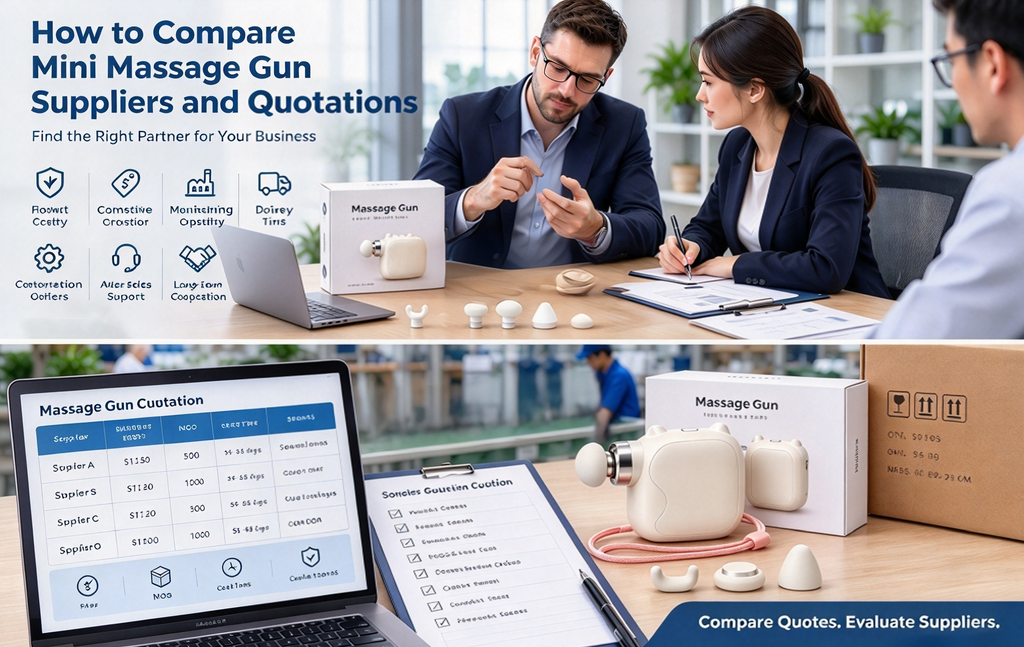
How to Compare Mini Massage Gun Suppliers and Quotations
Choosing the right mini massage gun supplier is an important decision for importers, distributors, private-label brands, and wholesale buyers. A competitive price may look attractive, but it does not always reflect product quality, manufacturing capability, delivery reliability, or the total cost of sourcing.
When comparing suppliers, B2B buyers need to look beyond the unit price. Motor performance, battery specifications, quality control, minimum order quantity (MOQ), customization options, and shipping arrangements can all affect the success of a purchasing project.
This guide explains how to evaluate suppliers and compare a massage gun quotation more effectively, helping your business reduce sourcing risks and build a reliable supply chain.
1. Compare Product Specifications Before Comparing Prices
The first step is to make sure every supplier is quoting the same product configuration. Two quotations may describe a mini massage gun, yet the products may differ significantly in materials, dimensions, motor type, battery capacity, accessories, and packaging.
For example, one supplier may offer a compact model with a brushless motor, while another quotes a different motor configuration or includes fewer accessories. Comparing their prices without checking these differences can lead to a misleading conclusion.
Ask each supplier to confirm:
Product dimensions, weight, and housing material
Motor type and available performance specifications
Battery capacity, charging method, and charging time
Number and types of massage heads
Speed settings and operating noise specifications, where available
Included accessories and standard packaging
For a fair comparison, prepare one standardized product specification sheet and send it to every shortlisted supplier. This makes it easier to identify genuine price differences rather than differences caused by product configuration.
2. Evaluate the Manufacturer’s Actual Capabilities
A professional website or attractive catalog does not necessarily prove that a company can manufacture your product consistently. Some businesses operate as trading companies, while others manage their own production or work with partner factories.
Neither model is automatically unsuitable. The important question is whether the supplier can meet your quality, customization, communication, and delivery requirements.
When evaluating a potential mini massage gun supplier, ask about its production process, assembly arrangements, quality inspection procedures, and experience with export orders.
Useful questions include:
Which production and assembly processes are managed in-house?
Can you provide current factory or production-line photos and videos?
How are incoming components and finished products inspected?
What production capacity is available for our expected order volume?
Can you support repeat orders with consistent specifications?
If you are working with a manufacturer, also ask how it manages component sourcing and production scheduling. A supplier that understands its supply chain can often explain potential bottlenecks before they affect delivery.
3. Request a Detailed Massage Gun Quotation
A useful massage gun quotation should provide more than a unit price. It should explain exactly what you are purchasing and which costs are included.
A quotation that appears cheaper may exclude logo printing, customized packaging, accessories, testing, or other services that another supplier includes in the price.
Request a written quotation covering the following details:
Unit price and quoted order quantity
MOQ for standard and customized products
Sample cost and sample delivery time
Logo printing, color, and packaging costs
Production lead time and order validity
Payment terms and accepted payment methods
Shipping terms and any excluded charges
Warranty conditions and after-sales support
Check whether the quoted price is based on EXW, FOB, or another agreed Incoterm. These terms affect which party is responsible for particular costs, risks, and transport arrangements.
For an accurate comparison, request the same order quantity, product configuration, packaging requirements, and delivery basis from each supplier.
4. Look Beyond the Lowest Unit Price
For B2B purchasing, the lowest price is not necessarily the lowest total cost. A cheaper product may require more inspection, generate more returns, or involve higher customization and logistics expenses.
Consider the total landed cost, including the product price, packaging, customization, inspection, freight, insurance, customs duties, taxes, and destination handling charges where applicable.
You should also consider the commercial cost of delays. If a shipment misses a product launch or seasonal sales window, the impact may be greater than a small difference in unit price.
A practical way to compare suppliers is to create a cost sheet with separate columns for quoted price, customization, packaging, logistics, estimated import charges, and other project-specific expenses.
Use confirmed figures whenever possible and label estimates clearly. This helps your purchasing team compare suppliers using a more realistic budget.
5. Check MOQ, Lead Time, and Production Flexibility
MOQ and lead time can determine whether a supplier fits your business model. A large distributor may need stable production capacity for recurring orders, while a growing brand may prefer a smaller initial order to test market demand.
Ask whether the MOQ changes for different colors, logo printing, packaging designs, or product configurations. A supplier may accept a lower quantity for a standard model but require a larger order for customized components.
Lead time should also be broken down into stages:
Sample development and approval
Artwork and packaging confirmation
Component procurement
Mass production and quality inspection
Packing and shipment preparation
This breakdown reveals where delays may occur. For customized orders, written approval of the final sample, logo artwork, packaging files, and product specifications can prevent avoidable rework.
Before placing an order, confirm whether the production schedule begins after deposit payment, sample approval, artwork approval, or another agreed milestone.
6. Assess Customization and OEM/ODM Support
For private-label brands and established distributors, customization can be an important competitive advantage. However, suppliers differ in how much customization they can support.
Some offer logo printing and standard packaging changes. Others may provide more extensive options, such as product colors, accessory combinations, packaging structures, or design development through OEM or ODM services.
When discussing customization, ask about additional costs, MOQ requirements, tooling fees if applicable, development time, and ownership of custom artwork or tooling.
One often-overlooked issue is color consistency between the approved sample and mass production. If your brand depends on a specific color, request an agreed color reference and clarify the acceptable variation before production.
You should also confirm how changes to the product specification will be handled. Even a small change to a component, battery, or accessory can affect cost, testing, production timing, or shipping documentation.
7. Verify Quality Control and Product Documentation
A supplier’s quality claims should be supported by clear procedures and relevant documentation. Ask how the company checks incoming components, monitors assembly, tests finished units, and records defects.
For mini massage guns, useful inspection points may include motor operation, charging functionality, battery performance, noise, surface finish, accessory fit, and packaging condition.
For larger orders, consider agreeing on an inspection plan before production begins. Define which tests will be performed, how defects will be classified, and what corrective action is expected if the goods fail the agreed requirements.
Also request applicable test reports and compliance documentation for your destination market. Requirements vary by product design and market, so avoid relying on a generic claim that a product is “certified” without confirming which model, components, and standards the documents cover.
If the product contains a lithium battery, confirm the relevant battery test documentation and transport requirements with the supplier and freight forwarder before shipment.
8. Evaluate Communication When Working With a New Supplier
Working with a new supplier does not have to be risky, but it does require a structured evaluation process. Early communication can reveal how carefully the supplier handles specifications, timelines, and commercial details.
Pay attention to whether the supplier answers technical questions directly, identifies limitations, and provides consistent information across its quotation, sample, and written correspondence.
Be cautious if a supplier repeatedly changes specifications, avoids confirming delivery dates, or offers unusually low prices without explaining the configuration.
Before committing to a large order, request a sample, verify the company’s business information, agree on written specifications, and consider a smaller initial order if commercially practical.
A new supplier should earn confidence through evidence and consistent execution—not simply through promises.
9. Compare After-Sales Support and Long-Term Reliability
The supplier relationship does not end when the goods leave the factory. For distributors and private-label businesses, a clear process for handling defects, replacement parts, and warranty claims is important.
Ask each supplier to explain its warranty policy, claim submission process, response time, and responsibilities when a quality issue is confirmed. Clarify whether spare parts are available and how replacements will be arranged.
For repeat orders, discuss how the supplier controls product changes. A component substitution that seems minor to the factory may affect your product’s performance or consistency.
Where appropriate, request advance notification and approval for material changes to key components or specifications. This is particularly valuable when building a long-term B2B product line.
10. Use a Standard Supplier Scorecard to Make the Final Decision
Once you have collected quotations and samples, use a consistent evaluation method rather than relying on first impressions.
A simple scorecard could assign weights to the factors most important to your business:
| Evaluation Factor | Suggested Weight |
| Product quality and sample performance | 25% |
| Total cost and quotation transparency | 20% |
| Manufacturing and quality control | 20% |
| Lead time and delivery reliability | 15% |
| Customization and MOQ flexibility | 10% |
| Communication and after-sales support | 10% |
Score each supplier against the same criteria. Adjust the weights to reflect your priorities, such as product customization, delivery speed, or price competitiveness.
The scorecard should support—not replace—basic due diligence. A supplier with a low price should not compensate for missing essential documentation or an unacceptable sample.

Conclusion: Choose a Mini Massage Gun Supplier for Long-Term Value
The best mini massage gun supplier is not necessarily the one offering the lowest quotation. For B2B buyers, the right partner combines competitive pricing with consistent product quality, transparent costs, reliable production planning, suitable customization, and clear after-sales support.
Before placing an order, standardize your product specifications, compare quotations on the same basis, test samples, verify documentation, and assess the supplier’s ability to support repeat business.
By using a structured evaluation process, your business can make a more informed sourcing decision, reduce avoidable purchasing risks, and establish a stronger foundation for long-term growth.